 Tiffany Knudsen, SMS

Falls can cause serious injuries, fatalities, and costly business disruption. Although Washington's Unified Safety Standards for Fall Protection have been in effect for several years, compliance requires ongoing attention as job duties, work locations, staffing, and equipment change.
The Washington State Department of Labor & Industries (L&I) establishes fall protection requirements through WAC 296-880, Unified Safety Standards for Fall Protection. Employers should evaluate the specific task and hazard rather than assume that a single trigger height or protection method applies to every situation.
When Is Fall Protection Required?
L&I uses different fall protection thresholds depending on the hazard and work activity. Common examples include:
Some hazards require protection regardless of height. Employers must guard open-sided floors, walkways, platforms, or runways above or adjacent to dangerous equipment. Holes that employees could trip, step into, or step through must be covered or guarded, and employees must be protected from impalement hazards, such as exposed reinforcing steel (rebar), other metal, or wood. Once employers identify the applicable hazard and trigger height, they must determine which protection method is permitted for the work being performed.
Understanding Common Fall Protection Systems
Fall protection is not limited to wearing a harness. The permitted system depends on the hazard, the work surface, the task, and the applicable provision of the rule.
Some systems, such as warning lines, safety monitors, and safety watches, are only permitted in limited situations and should not be assumed to be interchangeable with conventional fall protection methods.
When employers use personal fall protection systems, a harness alone is not enough. Employers must consider anchorage, connectors, fall clearance, swing-fall exposure, component compatibility, and manufacturer instructions. Before employees access an elevated surface, employers must ensure the surface is structurally sound. Personal fall-arrest, restraint, and positioning system components must be inspected before each use in accordance with the manufacturer's specifications, and any defective components must be removed from service.
Written Fall Protection Work Plans
When employees are assigned to workplace areas with fall hazards of 10 feet or more, employers must develop and implement a written fall protection work plan. A plan is not required when a guardrail system eliminates the fall hazard.
The plan must:
-
identify fall hazards
-
describe the fall-arrest or restraint methods to be used
-
address system assembly, maintenance, inspection, and disassembly
-
explain the handling and securing of tools and materials
-
address overhead protection
-
and describe the prompt, safe removal of injured workers
The plan must be available on-site for L&I inspection, and employees must be trained on its required elements before entering the affected area.
Training and Rescue Planning
A competent person must train each employee exposed to fall hazards. Employees must understand the hazards, when protection is required, the systems being used, and the procedures for erecting, inspecting, operating, maintaining, and removing those systems from service.
Before performing work that requires fall protection, employees must demonstrate that they understand the training and can use the protection properly. Employers must document training and provide retraining when changes or employee performance indicate that prior training is no longer adequate.
Effective training extends beyond preventing falls. Employees should understand the employer's rescue procedures and what to do if a fall occurs. Employers must provide for prompt rescue after a fall or ensure employees can self-rescue. Rescue planning should account for the work location, available equipment, communication methods, and the means of bringing a suspended employee to safety without delay.
Keep Fall Protection Practices Current
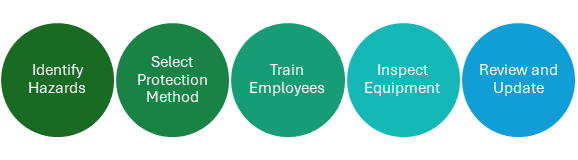
Employers should periodically review elevated work, fall protection plans, training, rescue procedures, and equipment inspection practices. Regular review can help identify gaps arising from changes in job duties, work locations, staffing, or equipment before an incident occurs.
Archbright Can Help!
L&I requirements vary by work activity, hazard, equipment, and industry. Archbright Members can find fall protection resources in the mozzo Resource Library, including:
Members can also use the mozzo Safety chat feature for help understanding and applying Washington requirements.
Not a member? Learn more about Archbright Membership.