3 min read

Stay Compliant With the Updated HazCom Standard Using mozzo’s SDS Tracker 

Stay Compliant With the Updated HazCom Standard Using mozzo’s SDS Tracker 

Chemical safety has always been a pillar of a strong workplace safety culture, but today's expectations look very different from the days of a dusty binder on a shelf. As regulations evolve and hazards become more complex, employers are being asked to take a more active role in ensuring workers have real-time access to accurate, up-to-date chemical information. 

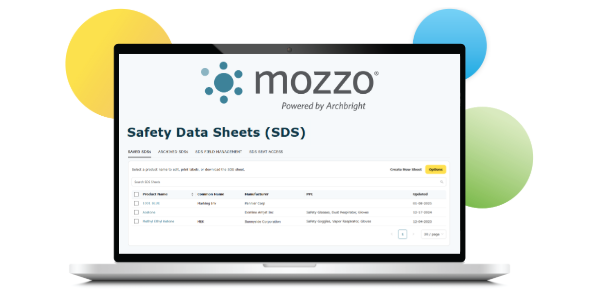
OSHA's most recent updates to the Hazard Communication Standard (HazCom) underscore the importance of clear, accessible Safety Data Sheets (SDSs). To help organizations meet these expectations with confidence and clarity, Archbright created the mozzo SDS Tracker. This cloud-based tool makes chemical information easier to access, manage, and share across the workplace. 

What Is HazCom—and Why Does It Matter? 

OSHA's Hazard Communication Standard exists for one core purpose: to ensure that workers have the right to understand the chemical hazards they may be exposed to on the job. 

To fulfill that right, employers must: 

  • Identify hazardous chemicals in the workplace
  • Maintain Safety Data Sheets for each chemical 
  • Label chemicals appropriately 
  • Train employees on the hazards and how to work safely
  • Develop a written program describing how the above elements are implemented 

In other words, HazCom is a communication standard, not just a documentation standard. If employees can't easily find and understand the information they need, the system breaks down. 

Understanding Safety Data Sheets (SDSs) 

Safety Data Sheets are the heart of HazCom. They provide workers with essential information such as: 

  • Physical and health hazards
  • Required personal protective equipment (PPE)
  • Safe handling and storage instructions
  • Spill, exposure, and emergency response guidance
  • Toxicological details 

In an emergency, the SDS becomes a lifeline, helping employees and first responders act quickly and safely. Because of this, OSHA requires SDSs to be current, accurate, and easy for workers to locate and use. OSHA's recent HazCom updates deepen the importance of maintaining high-quality SDSs across the entire workplace. 

What Changed in OSHA's 2024 HazCom Update? 

In 2024, OSHA revised its HazCom standard to align more closely with the Globally Harmonized System (GHS) Revision 7, enhancing the clarity and consistency of hazard communication. 

Key changes include: 

  • Updated Hazard Classifications—OSHA refined how several types of hazards are defined and classified, including:
     
    • Flammable gases
    • Aerosols
    • Pressurized chemicals ("chemicals under pressure")
    • Certain solvents and irritants 

These changes may shift how common materials are categorized—even though the chemicals themselves haven't changed. For example: 

  • Compressed gases like nitrogen or argon may now fit into new "chemicals under pressure" categories.
  • Certain cleaning solvents previously labeled as "irritants" may now be classified as "skin corrosives," requiring updates to training and PPE procedures.
  • More Detailed and Readable SDS and Label Requirements—Sections related to hazard identification, toxicology, and physical hazards now require clearer and more consistent information. Employers will need to ensure SDSs reflect these updated criteria. 

Extended Compliance Deadlines: What Employers Should Know 

On January 15, 2026, OSHA announced an extension of the compliance deadlines for its 2024 updates. Initially, manufacturers, importers, and distributors had to evaluate specific substances by January 19, 2026, but this deadline has been pushed back to May 19, 2026. All other compliance dates are also delayed by four months.  

The revised schedule is now as follows: 

Compliance Date 

Applies To 

Requirement(s) 

May 19, 2026 

Chemical manufacturers, importers, and distributors (Substances) 

Must comply with all modified provisions for substances, including updated labels and Safety Data Sheets (SDSs). 

November 20, 2026  

Employers (Substances)  

Must update alternative workplace labeling, revise Hazard Communication Programs, and train employees on any newly identified physical or health hazards for substances

November 19, 2027 

Chemical manufacturers, importers, and distributors (Mixtures) 

Must comply with all modified provisions for mixtures, including updated labels and SDSs. 

May 19, 2028 

Employers (Mixtures) 

Must update workplace labels, revise Hazard Communication Programs, and train employees on any newly identified hazards associated with mixtures

While these extensions help, they don't change existing requirements, nor soften inspector expectations. Inspectors will still expect SDS access to be immediate, accurate, and well-organized. Employers who begin updating their SDS collections early will avoid last-minute scrambles and better support employee safety in the meantime.  

Employers in states with state-run safety programs, such as California, Oregon, or Washington, should also be aware that their state agencies may adopt differing requirements or implementation timelines. While these state programs must remain at least as effective as federal OSHA, they have up to six months to update their own standards following a federal change. Employers should continue to monitor updates from their local regulatory agencies to ensure full compliance. 

How the mozzo SDS Tracker Supports Compliance—Without the Complexity 

The mozzo SDS Tracker helps employers meet OSHA's updated HazCom requirements by centralizing chemical safety information in a single, cloud-based system. Employees can quickly access SDSs from any device. At the same time, employers can organize and search documents, associate SDSs with specific locations or departments, and track where chemicals are used across the workplace.  

The platform also supports printing secondary container labels (GHS, HMIS, or NFPA formats) in custom sizes and archiving SDSs for the required 30-year retention period, helping organizations stay compliant as hazard classifications and documentation requirements evolve. By making chemical information easier to find, maintain, and trust, the SDS Tracker reduces administrative burden and supports a clearer, more confident safety culture. 

A Proactive Approach to Chemical Safety 

Chemical safety should never be reactive. When SDSs are easy to find, understand, and keep up to date, employers are better protected, employees feel safer, and the organization is better prepared for emergencies and inspections. With OSHA's updated HazCom rules now in effect, this is the ideal time for employers to evaluate how SDS information is managed in their workplaces.  

For a demo of the SDS tool in mozzo, please schedule a time here.

Start with People: The Power of Check-Ins in Meetings

Start with People: The Power of Check-Ins in Meetings

In today’s fast-paced work environment, meetings often become transactional—focused solely on metrics, tasks, and deadlines. While efficiency...

Read More
Navigating Federal and State-Required Heat Prevention Plans

Navigating Federal and State-Required Heat Prevention Plans

NASA's Goddard Institute for Space Studies (GISS) scientists reported that July 2023 was the hottest month on record globally. Unfortunately, experts...

Read More
Fall Protection Rule Updates for Washington State

Fall Protection Rule Updates for Washington State

Do your employees work from heights in the state of Washington? If so, you may need to brush up on the Washington Labor and Industries’ (L&I) updated...

Read More